
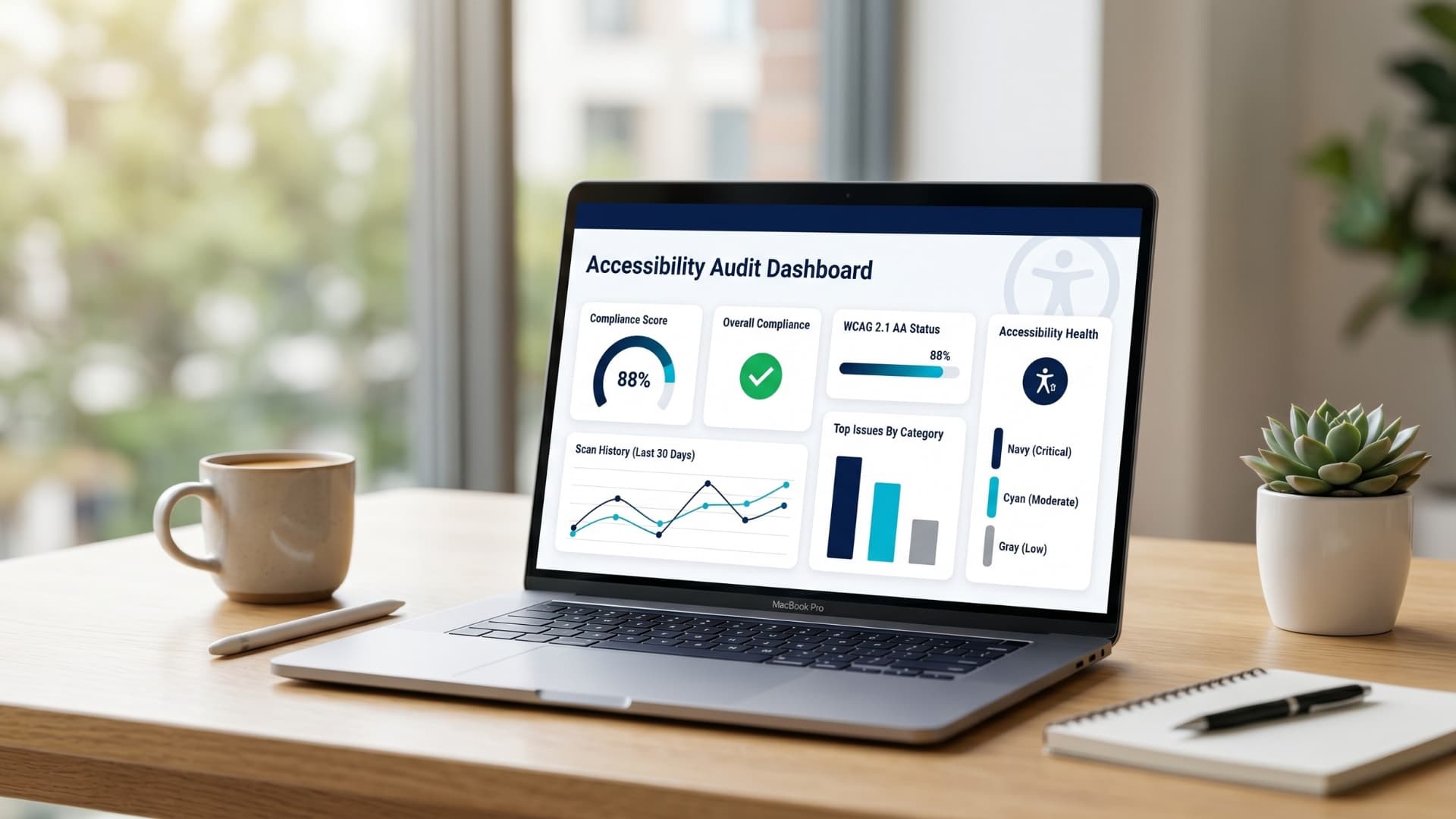
Since 28 June 2025, Germany's Barrierefreiheitsstärkungsgesetz (BFSG) — the national implementation of the European Accessibility Act — has been in force. The first cease-and-desist waves are rolling. And as an agency or IT service provider, you're caught in the middle.
Your clients are asking frantically about compliance. You're expected to deliver. The market is flooded with tools claiming "BFSG-compliant in one click" or "100% WCAG coverage automatically." Look closer and you'll see quickly: that's marketing nonsense. No tool in the world can cover 100%. The honest figure is around 57%. More on that in a moment.
In this article we show you what the most popular tools actually check, where the gaps are, and why our BarriereCheck catches exactly the issues that consumer protection associations are currently sending letters about. You'll also get a direct comparison table, a decision guide, and at the end a FAQ section with the questions your clients are asking you right now.
Brief and to the point, because the legal details are available elsewhere. The BFSG transposes EU Directive 2019/882 (European Accessibility Act) into German law. It affects all companies offering digital services to consumers — online shops, booking portals, banking, anything that isn't purely B2B or a simple brochure website. Exception: micro-enterprises with fewer than 10 employees and under €2 million in revenue. But as soon as you have a contact form or a booking function, you're generally in scope.
The technical basis is EN 301 549, which in turn references WCAG 2.1 Level AA. Practically speaking: your website must work with screen readers, be operable via keyboard, have sufficient contrast, clear structure, alt texts, and so on.
But here's the point that 90% of tools on the market sweep under the rug. The BFSG requires not just technical conformity. It additionally requires:
These points are the primary attack surface for cease-and-desist letters. And they are simply ignored by most tools.
Related tool
Start BarriereCheck now
From €29 per analysis. Results in 1–3 minutes. BFSG-compliant report in German.
A cease-and-desist costs €3,000–10,000. BarriereCheck costs €29.
GDPR compliant · No data sharing
Interactive quick check
1.Do you offer digital products or services to consumers?
2.Do you run an online shop, booking system or SaaS product?
3.Does your company have 10 or more employees or more than €2M annual revenue?
Before we look at each tool individually, a number nobody likes to tell you. Even the best engine in the world — axe-core from Deque Systems — finds on average only 57% of WCAG violations automatically. That's Deque's own figure, based on over 13,000 audits. axe-core is the engine that almost all serious tools use under the hood: Lighthouse, Pope Tech, many others. They all share the same ceiling.
What this means in practice: if a tool promises you "100% conformity, automated," it's lying. Full stop. The meaningfulness of alt texts, the descriptiveness of link texts, logical heading hierarchy, the practical screen reader experience — these things need human eyes.
Realistically, depending on the tool, automated coverage sits between 30 and 60 percent. The rest is manual. This isn't a weakness of our market; it's the physical limit of automated testing. Those who communicate honestly win in the long run.
Lighthouse is free and built directly into Chrome. Open DevTools, click Lighthouse, choose Accessibility, Run. Done. You get a score from 0 to 100 and a list of findings in English.
What Lighthouse does well: Fast. Free. Every developer already has it open. Engine is axe-core, so it's credible.
What Lighthouse doesn't do: It checks exactly one URL. It speaks no German. It produces no report you can hand to a managing director. It doesn't check for BFSG. No accessibility statement, no feedback mechanism, no PDFs on the site, no cookie banner audit, no multi-page crawl. It's a developer tool. Not a compliance tool for your clients.
If you want to provide clients with an on-demand status that holds up in court, Lighthouse isn't enough. It's the foundation, not the result.
WAVE is the free browser extension from WebAIM. Also credible, also open source, with visual marking directly on the page. Pope Tech builds on WAVE and offers a platform for multiple websites with scheduling and reporting. Pope Tech has even added PDF scanning since early 2026, which many other tools lack.
What's good: WAVE marks problems visually right on the page. Pope Tech scales to agencies monitoring many clients simultaneously.
What's missing: Again, no explicit BFSG compliance check. Pope Tech is in English and primarily targets US clients with ADA and Section 508. The German BFSG specifics — such as the accessibility statement or the competent market surveillance authority MLBF Magdeburg — are not in focus. Pope Tech starts at around €390 per year for small setups, quickly much more at higher tiers.
The original from Deque. Free browser extension in the free version, plus a Pro variant with semi-automated "Intelligent Guided Tests" that guide manual checks. Anyone who really wants to dive deep into WCAG can't avoid axe.
What's good: Probably the most precise engine on the market. The Pro variant additionally covers topics like Focus Appearance, Focus Not Obscured, and some WCAG 2.2 specifics.
What's missing: English only. A developer tool, not a client report. Pro variant costs from $50 per seat per month, so from $600 per user per year. Also zero German BFSG relevance.
Here it gets interesting. Overlays are solutions you embed with one line of code that then display a small accessibility icon on your site, through which users can adjust font size, contrast, and so on. They promise "compliance in one click."
The reality: the German federal and state supervisory authority for accessibility has clearly positioned itself against them. accessiBe was fined $1 million by the US FTC in 2025 for misleading advertising. When a tool promises "full conformity" but demonstrably doesn't deliver it, that's consumer deception. In Germany too there are already legal corrections to such advertising claims.
Prices: accessiBe widget between $490 and $950 per year. Managed plans up to $5,940. Enterprise from $10,000. Eye-Able as a German provider plays in a similar league.
My advice as an agency: Overlays are politically sensitive. You install them for a client and then you're implicated when the provider runs into trouble. On top of that, overlays are often experienced as disruptive by people with disabilities. They don't fix bad code structures — they overlay them. If your clients want compliance, fix the substance. Skip the overlays.
The enterprise classic. If you advise a bank, an insurance company, or a government agency, SiteImprove will come up eventually. Full platform, governance model, site-wide scanning, workflow management.
What's good: If you want to manage hundreds of websites, SiteImprove is genuinely strong. Reporting is enterprise-grade.
What's missing: Money. SiteImprove costs between $15,000 and $50,000 per year and upwards. For an agency with 10 clients each paying €3,000 in fees, that's absurd. On top of that, it's a sales process involving demos, sales calls, and proposals. You're not compliant in 5 minutes — you're onboarded in 5 weeks.
| Feature | Lighthouse | WAVE / Pope Tech | axe DevTools | Overlays | SiteImprove | FlowResults BarriereCheck |
|---|---|---|---|---|---|---|
| Price (per year) | €0 | €0 to ~€1,500 | €0 to ~€600 per seat | from ~€460 to €10,000+ | from ~€14,000 | From €29 per analysis, €79 for 10-pack |
| German language | No | No | No | Partly | Partly | Yes |
| BFSG-specific checks | No | No | No | Claims yes, factually no | Partly | Yes |
| Accessibility statement check | No | No | No | No | Partly | Yes |
| Cookie banner audit | No | No | No | No | No | Yes |
| PDF audit (PDF/UA) | No | Pope Tech yes | No | No | Yes | Yes |
| Multi-page crawl | No | Yes (Pope Tech) | No | Indirectly | Yes | Yes |
| Cease-and-desist risk score | No | No | No | No | No | Yes |
| Executive-ready report | No | Partly | No | Marketing claims | Yes | Yes |
| Time to result | Instant | Instant | Instant | Sales process | Weeks | 1 to 3 minutes |
| Replaces manual audit? | No | No | No | Claims yes, isn't so | Partly | No, honestly communicated |
The result of this table is pretty clear. There are cheap developer tools, there are expensive enterprise solutions, and there are overlays you're better off avoiding. What's missing is exactly the segment where agencies and IT service providers operate. Fast, German, BFSG-compliant, forwardable to the client, affordable per project.
Under the hood, we use the same engine as Lighthouse and axe DevTools: axe-core from Deque. This puts us on the same technical level as the professional tools. That's the foundation. On top of that come eight modules that no other tool in the €29 price range delivers.
1. Multi-page crawling. We don't just check your homepage. We automatically crawl the page types most relevant for BFSG: homepage, imprint, privacy policy, T&Cs, accessibility statement, contact page, a product page, a category page, login, checkout if present. Up to 10 pages depending on the plan. Because BFSG requires conformity of the service, not just the landing page.
2. Accessibility statement check. This is a mandatory requirement under §14 BFSG and Annex 3. We look for the statement in the footer and navigation, checking all mandatory components: scope, conformity status, standard reference, feedback contact, market surveillance authority, update date, consumer information. If any of these is missing, you'll know. This is currently the most common basis for cease-and-desist letters.
3. Cookie banner audit. Cookie banners are often themselves not accessible. We check whether "Accept" and "Decline" are equivalent, whether keyboard navigation works, whether ARIA-modal is set correctly, whether focus moves properly. Sounds technical — but it's practical. Shops are currently losing proceedings over this.
4. PDF audit (PDF/UA). We crawl PDFs on your site and check whether they are tagged, have a language defined, and have a title. Invoices, data sheets, terms and conditions as PDFs — all potential barriers, all potential grounds for legal action.
5. Reflow and zoom test. We load your page at 320 pixel viewport width and check whether content is cut off. Mandatory criterion WCAG 1.4.10. Frequently failed, easy to fix once you know.
6. Non-text contrast for UI elements. axe-core only checks text contrast. We additionally check the borders of your buttons and form inputs. If the 3:1 contrast ratio isn't met, it's flagged. WCAG 1.4.11.
7. Reduced motion respect. If a user has enabled "reduce motion" in their operating system, animations must not continue running. We test this automatically. Auto-play on videos and carousels is also detected.
8. Form deep analysis and CAPTCHA detection. We check whether form fields have the correct autocomplete attributes (WCAG 1.3.5), whether required fields are visibly marked, and we detect reCAPTCHA and hCaptcha as potential barriers with guidance on accessible alternatives.
We also include a Flesch readability analysis for German content, all findings annotated with concrete BFSG and WCAG legal references, and a report in HTML and PDF that you can forward to clients without any rework.
This is the point that sets us apart from everything else on the market. We don't just give you a WCAG score from 0 to 100. We give you a parallel cease-and-desist risk score.
The difference: a WCAG score is academic. A page can score 65 out of 100 and still be safe from legal action because the serious mandatory violations are absent. Another page scores 80 out of 100 and is still a cease-and-desist magnet because the accessibility statement is missing and the cookie banner is broken.
Our risk score weights findings by what actually leads to legal proceedings. Missing accessibility statement: 30 points. Cookie banner without a decline button: 20 points. Contrast errors: 1 to 2 points per element. This gives you at a glance the answer your clients actually want. How great is the risk that a lawyer's letter arrives next week?
You're a solo freelancer or web designer with fewer than 5 clients: Lighthouse plus BarriereCheck single purchase for €29 per client. That's all you need. Use the Lighthouse output while building, pass the BarriereCheck to the client. Done.
You're a small agency with 5 to 30 clients: Our 10-pack for €79 covers almost any quarterly routine. €8 per client. Less than an hour of consulting work, but a complete report with legal references.
You're an IT service provider or larger agency: You need monitoring. Check out our Portfolio Health Monitor setup. Daily scanning of all client websites, Slack alerts, white-label reports. All in one.
You serve enterprises (banks, insurers, corporations): SiteImprove or axe DevTools Pro plus manual audit is the right call. Those are different financial and risk categories, and our tool isn't the right entry point for that segment.
Theory is one thing. You'll only truly understand what we deliver once you've had the report in your hands. So here's the suggestion: pick a client website that you yourself think should be basically fine. Order a single BarriereCheck for €29. Compare the result with what Lighthouse gives you.
If the report doesn't convince you, you've invested €29 and have a comparison you can use internally. If it does convince you, you have a tool for every client meeting for the coming months.
No. Lighthouse checks only one URL, is in English, and contains none of the BFSG-specific mandatory checks like the accessibility statement or cookie banner audits. It's a technical aid for developers, not a compliance tool.
A manual audit by certified auditors typically costs between €1,500 and €5,000 per website, depending on scope. Automated tools like BarriereCheck cover the majority of the most common violations and cost from €29 per analysis. For small to medium sites, the combination of automated initial check plus selective manual follow-up offers the best value for money.
No. German supervisory authorities reject overlays as a full replacement for accessibility. Additionally, accessiBe was fined $1 million by the US FTC in 2025 for misleading advertising. Overlays can improve individual aspects, but they don't replace sound code structures.
Up to €100,000 per case. Add to that distribution bans for non-compliant services and competition-law cease-and-desist actions by competitors or consumer protection associations under §3a UWG.
All providers of digital services for consumers — online shops, booking portals, banks, insurance companies, communication services. Only micro-enterprises with fewer than 10 employees and under €2 million in revenue are exempt, provided they don't offer consumer services.
Under Annex 3 BFSG: description of the service, explanations for use, degree of fulfilment of accessibility requirements, designation of the market surveillance authority, consumer information pursuant to Art. 246 EGBGB. A feedback mechanism and the date of last update are also recommended.
A maximum of 57 percent. This figure comes from Deque Systems based on over 13,000 audits with axe-core. Tools that promise more are not credible. The rest requires manual review by humans.
axe-core with full WCAG 2.1 and 2.2 coverage, plus 13 manual DOM categories, plus German Flesch readability analysis. On top: multi-page crawl, accessibility statement audit, cookie banner check, PDF audit (PDF/UA), reflow test, non-text contrast, reduced motion, form deep analysis, CAPTCHA detection. Output is a German HTML and PDF report with a school grade, WCAG score, and cease-and-desist risk score.
Between 1 and 3 minutes. You enter the URL and the report arrives by email.
In the 10-pack and higher tiers, yes. Get in touch and we'll sort it out.
The market for accessibility tools is full of promises that aren't kept. Overlays claiming to solve everything. Enterprise platforms that are unaffordable for agencies. Developer tools that deliver only 50 percent of the truth.
We build FlowResults for those who work between these worlds — agencies, IT service providers, web designers — who need a report they can put directly in their clients' hands. With German context, BFSG relevance, a focus on legal risk, and at the price of an hour's consulting.
If you haven't tried the tool yet, start with the single purchase. If you have questions, write to us.
Start BarriereCheck now
From €29 per analysis. Results in 1–3 minutes. BFSG-compliant report in German.
A cease-and-desist costs €3,000–10,000. BarriereCheck costs €29.
GDPR compliant · No data sharing
“I thought accessibility didn't apply to me. BarriereCheck found 14 critical issues — and showed me exactly what to fix before the BFSG deadline.”
Tobias K. · Inhaber, Online-Shop